
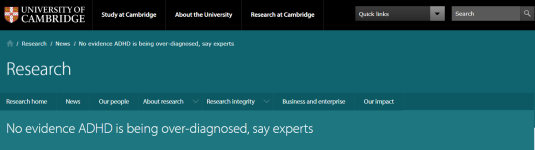
Experts say ADHD is not over-diagnosed in the UK; instead, many people wait too long for assessment, support and treatment. A paper in the British Journal of Psychiatry challenges the growing claim that “everyone has ADHD,” arguing the bigger issue is unmet need.
Professor Tamsin Ford said: “Overdiagnosis is not a problem, but misdiagnosis may be as people are driven into the private sector by long waits; and sadly, missed diagnoses remain common.”
Research suggests ADHD affects about 5% of children and 3% of adults, yet NHS diagnosis rates remain lower, indicating many people go undiagnosed. Long waiting lists—sometimes years—are pushing some people toward private assessments.
Professor Samuele Cortese added: “While misdiagnosis and inappropriate diagnosis do occur, the available evidence indicates that under-diagnosis and under-treatment remain the predominant challenges.”
Experts warn untreated ADHD is linked to serious risks, including academic failure, substance misuse and suicide, and call for better funding, workforce training and improved access to diagnosis and care.
More here: https://www.cam.ac.uk/research/news/no-evidence-adhd-is-being-over-diagnosed-say-experts
Reference
Cortese, S et al. ADHD (over) diagnosis: fiction, fashion, and failure. British Journal of Psychiatry; 6 March 2026; DOI: 10.1192/bjp.2026.10546
Professor Tamsin Ford said: “Overdiagnosis is not a problem, but misdiagnosis may be as people are driven into the private sector by long waits; and sadly, missed diagnoses remain common.”
Research suggests ADHD affects about 5% of children and 3% of adults, yet NHS diagnosis rates remain lower, indicating many people go undiagnosed. Long waiting lists—sometimes years—are pushing some people toward private assessments.
Professor Samuele Cortese added: “While misdiagnosis and inappropriate diagnosis do occur, the available evidence indicates that under-diagnosis and under-treatment remain the predominant challenges.”
Experts warn untreated ADHD is linked to serious risks, including academic failure, substance misuse and suicide, and call for better funding, workforce training and improved access to diagnosis and care.
More here: https://www.cam.ac.uk/research/news/no-evidence-adhd-is-being-over-diagnosed-say-experts
Reference
Cortese, S et al. ADHD (over) diagnosis: fiction, fashion, and failure. British Journal of Psychiatry; 6 March 2026; DOI: 10.1192/bjp.2026.10546


 can they actually say this in writing, shocking


 (Spelling is only a convention anyway. Shakespeare spelt his own name in at least three different ways, and his contemporaries found eighty ways more!).
 )
)