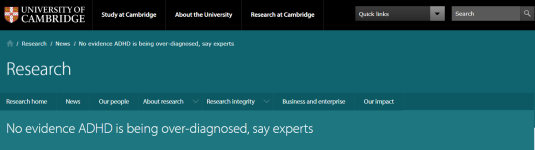
ADHD is under diagnosed and under treated, experts say

Experts say ADHD is not over-diagnosed in the UK; instead, many people wait too long for assessment, support and treatment. A paper in the British Journal of Psychiatry challenges the growing claim that “everyone has ADHD,” arguing the bigger issue is unmet need.


Professor Tamsin Ford said: “Overdiagnosis is not a problem, but misdiagnosis may be as people are driven into the private sector by long waits; and sadly, missed diagnoses remain common.”


Research suggests ADHD affects about 5% of children and 3% of adults, yet NHS diagnosis rates remain lower, indicating many people go undiagnosed. Long waiting lists—sometimes years—are pushing some people toward private assessments.


Professor Samuele Cortese added: “While misdiagnosis and inappropriate diagnosis do occur, the available evidence indicates that under-diagnosis and under-treatment remain the predominant challenges.”


Experts warn untreated ADHD is linked to serious risks, including academic failure, substance misuse and suicide, and call for better funding, workforce training and improved access to diagnosis and care.

More here: https://www.cam.ac.uk/research/news/no-evidence-adhd-is-being-over-diagnosed-say-experts

Reference
Cortese, S et al. ADHD (over) diagnosis: fiction, fashion, and failure. British Journal of Psychiatry; 6 March 2026; DOI: 10.1192/bjp.2026.10546
1772812606788.png
 
  • Like
Reactions: Chill-E
Hi Margot

Thanks for posting this.

I may have discovered one reason that ADHD is undiagnosed and untreated in my area.

Following a referral to Pennine Care NHS Foundation Trust Adult ADHD service over 12 months ago, last week I received a letter rejecting my referral due to “numerous issues” as follows:

“The diagnosis of Adult ADHD can also be unreliable in people over the age of 60 due to the possibility of missing important differential diagnoses such as dementia.”

“Treatment of ADHD in the over 60s is also often contraindicated by the cardiovascular side effects that can be caused. Due to these reasons it gives a reasonable clinical rationale to exclude the referral for ADHD assessment to people over the age of 60”

It appears in my area we have a service led by people who:

1. Have not read the NICE guidelines 87. Age is not a contradiction to assessment and treatment.

2. Do not understand that the over 60s can very adequately be diagnosed and treated by both stimulant and non stimulant medications without significant side effects by clinicians with a full understanding of ADHD and the complete range of therapeutic approaches.

3. Appear to not have the necessary clinical skills to differentiate between ADHD and Dementia.

4. Discriminate purely on the basis of age. There is no clinical justification for rejecting this referral. This contravenes the Equality Act of 2010.

Quite obviously the approach that this service is taking is fundamentally flawed. I have initiated a PALS complaint against the clinicians who run this “service” (my inverted commas). I will keep you all updated on developments. I fear this could become a saga of epic proportions. I will keep you updated. Meanwhile my typing finger and Chat GPT are composing a letter to my MP Jon Pearce who has taken an interest in AuDHD and Autism services.

If anyone else has received a similar rejection I would be pleased to hear from them. Perhaps we can coordinate our efforts.

Wade

(Anyone who knows me, knows that I have been diagnosed AuDHD in the last 18 months, no thanks to the “service” above. I have received outstanding support from NDSA, my Pathway course mentor and all my fellow mentees. I have had very effective help through prescribed stimulant medication and understanding the nature of ADHD, learning new skills and management strategies).
 
Last edited:
Hi Margot

Thanks for posting this.

I may have discovered one reason that ADHD is undiagnosed and untreated in my area.

Following a referral to Pennine Care NHS Foundation Trust Adult ADHD service over 12 months ago, last week I received a letter rejecting my referral due to “numerous issues” as follows:

“The diagnosis of Adult ADHD can also be unreliable in people over the age of 60 due to the possibility of missing important differential diagnoses such as dementia.”

“Treatment of ADHD in the over 60s is also often contraindicated by the cardiovascular side effects that can be caused. Due to these reasons it gives a reasonable clinical rationale to exclude the referral for ADHD assessment to people over the age of 60”

It appears in my area we have a service led by people who:

1. Have not read the NICE guidelines 87. Age is not a contradiction to assessment.

2. Do not understand that the over 60s can very adequately be diagnosed and treated by both stimulant and non stimulant medications without significant side effects by clinicians with a full understanding of ADHD and the complete range of therapeutic approaches.

3. Appear to not have the necessary clinical skills to differentiate between ADHD and Dementia.

4. Discriminate purely on the basis of age. There is no clinical justification for rejecting this referral. This contravenes the Equality Act of 2010.

Quite obviously the approach that this service is taking is fundamentally flawed. I have initiated a PALS complaint against the clinicians who run this “service” (my inverted commas). I will keep you all updated on developments. I fear this could become a saga of epic proportions. I will keep you updated. Meanwhile my typing finger and Chat GPT are composing a letter to my MP Jon Pearce who has taken an interest in AuDHD and Autism services.

If anyone else has received a similar rejection I would be pleased to hear from them. Perhaps we can coordinate our efforts.

Wade

(Anyone who knows me, knows that I have been diagnosed AuDHD in the last 18 months, no thanks to the “service” above. I have received outstanding support from NDSA, my Pathway course mentor and all my fellow mentees. I have had very effective help through prescribed stimulant medication and understanding the nature of ADHD, learning new skills and management strategies).
Keep us all posted Wade - am sure they will carefully consider their response to your complaint

Also everything that has potential to have side effects - means no treatment as they want "no risk" - surely they don't understand the arena they are operating in

I'm starting my ADHD meds privately soon (just over a week to my first appointment) not sure how I will get shared care when my local NHS has basically stopped takign referrals with no timeframe announced when they will start up again NHS Berkshire Suspends new ADHD referral . I will see if my GP will do a shared care with my prescriber (covered by insurance for 2 years), but the meds I have to fund myself
 
Wow 😲 can they actually say this in writing, shocking

I read this week in relation to autism that between 1980 and 2020s there has been over 40,000 pieces of research on children but only I think 174 on adults, this tells us that the health professionals just don't know how as adults we are affected,

Apparently there is Virtually a "black hole of research in the over 60s." Most clinical trials for ADHD medications strictly exclude people over 65, leading to a lack of "gold-standard" data.

And AuDHD, well they only recognised this in 2013, and to say you can't be assessed because of dementia risk is odd because you have to prove you have signs of ADHD since childhood, so if you are reporting forgetfulness, tine blindness etc now, why would dementia be the cause of you can demonstrate this has always been a problem


There has equally very little research on women and girls with autism, hence much of the current diagnostic criteria are very male biased. Gina Ripon's book The Lost Girls of Autism is fascinating. She's also been interviewed recently by Ben on the Hidden 20% podcast discussing this.
FYI I am 61 and a newly diagnosed autistic. I never suspected I was autistic and I'm still coming to terms with what it means.
 
Gina's book is about the lack of research and understanding of female autism. It might be useful reading for the person who wrote the controversial article in the TES.
It's not really about work. I have a part time job which is as much as I can manage as I'm struggling with burnout, and as I'm over 60 am looking to retirement not a new career.
 
Wow 😲 can they actually say this in writing, shocking

I read this week in relation to autism that between 1980 and 2020s there has been over 40,000 pieces of research on children but only I think 174 on adults, this tells us that the health professionals just don't know how as adults we are affected,

Apparently there is Virtually a "black hole of research in the over 60s." Most clinical trials for ADHD medications strictly exclude people over 65, leading to a lack of "gold-standard" data.

And AuDHD, well they only recognised this in 2013, and to say you can't be assessed because of dementia risk is odd because you have to prove you have signs of ADHD since childhood, so if you are reporting forgetfulness, tine blindness etc now, why would dementia be the cause of you can demonstrate this has always been a problem


Hi Bluelyn,

They very definitely have put this in writing. I think they may live to regret their ill considered correspondence. I intend to do everything I can to make them change their policy. I believe this to be a cynical attempt to reduce their waiting list to comply with targets and save money.

You do make an excellent point regarding the lack of research into Neurodivergence in the over 60s. This will inevitably lead to poor health and social care in our later years. Hopefully all young Neurodivergent people will become old Neurodivergent people. We need to understand how we respond to medication, how our needs may change with physical and cognitive decline. Unfortunately old age and mental health are very much the neglected areas of health and social care. They are not “sexy” to the media or politicians, yet they impact the majority of people directly or indirectly during their life.

Regarding clinical trials and the evidence base for ADHD medications you may be interested in this web site:


I was introduced to this through a recent “ADDitude” webinar by Samuele Cortese a Psychiatrist working in the UK. As you correctly say, there a few studies on those aged 60+ that last any significant time. Given the number of late diagnosed ADHDers that are being treated with stimulant and non stimulant medication, there really should be a data base and research into the long term effects.

Whilst I’m not overly concerned at the present time for myself, as I feel I am being closely monitored for side effects, I would really like there to be some quality research to inform prescribing in my later years. As with all medication it boils down to a personal risk/benefit analysis. You cannot make a truely informed decision without some robust research results. At the present time for me the benefits very much outweigh the risks, but I’m very aware that as organ function declines, drug metabolism and pharmacodynamics will change.

Thank you for your thought provoking contribution to this thread.

Wade
 
Hi Bluelyn,

They very definitely have put this in writing. I think they may live to regret their ill considered correspondence. I intend to do everything I can to make them change their policy. I believe this to be a cynical attempt to reduce their waiting list to comply with targets and save money.

You do make an excellent point regarding the lack of research into Neurodivergence in the over 60s. This will inevitably lead to poor health and social care in our later years. Hopefully all young Neurodivergent people will become old Neurodivergent people. We need to understand how we respond to medication, how our needs may change with physical and cognitive decline. Unfortunately old age and mental health are very much the neglected areas of health and social care. They are not “sexy” to the media or politicians, yet they impact the majority of people directly or indirectly during their life.

Regarding clinical trials and the evidence base for ADHD medications you may be interested in this web site:


I was introduced to this through a recent “ADDitude” webinar by Samuele Cortese a Psychiatrist working in the UK. As you correctly say, there a few studies on those aged 60+ that last any significant time. Given the number of late diagnosed ADHDers that are being treated with stimulant and non stimulant medication, there really should be a data base and research into the long term effects.

Whilst I’m not overly concerned at the present time for myself, as I feel I am being closely monitored for side effects, I would really like there to be some quality research to inform prescribing in my later years. As with all medication it boils down to a personal risk/benefit analysis. You cannot make a truely informed decision without some robust research results. At the present time for me the benefits very much outweigh the risks, but I’m very aware that as organ function declines, drug metabolism and pharmacodynamics will change.

Thank you for your thought provoking contribution to this thread.

Wade
I'm late diagnosed autistic at 61. It was suggested by both my counsellor and the CMHT assessment. I have to confess a major reason for getting a formal diagnosis is to push for adequate accommodations for any care I may need as I get older. I'm a former nurse, so the idea of being forced to sit in a noisy, brightly lit hospital ward 24/7 fills me with horror and should I need to go into a care home I'd want them to understand my autism.
These and general quality of life are the reason why late diagnosis is valid, and you must fight such arbitrary reasons for refusing you NHS care. Have you written to your MP or one of the many speaking out about their ADHD? It's outrageous your referral has been rejected purely on she grounds. We may have struggled and felt judged our entire lives so far, but we should able to enjoy our old age free from such judgement, safe in the knowledge that we can now get help and the needed accommodations going forward.
 
Last edited:
I'm late diagnosed autistic at 61. It was suggested by both my counsellor and the CMHT assessment. I have to confess a major reason for getting a formal diagnosis is to push for adequate accommodations for any care I may need as I get older. I'm a former nurse, so the idea of being forced to sit in a noisy, brightly lit hospital ward 24/7 fills me with horror and should I need to go into a care home I'd want them to understand my autism.
These and general quality of life are the reason why late diagnosis is valid, and you must fight such arbitrary reasons for refusing you NHS care. Have you written to your MP or one of the many speaking out about their ADHD? It's outrageous your referral has been rejected purely on she grounds. We may have struggled and felt judged our entire lives so far, but we should able to enjoy our old age free from such judgement, safe in the knowledge that we can now get help and the needed accommodations going forward.
Hi Lovely Cat Lady

I’m a late diagnosed AuDHD AT 64. I was also a health care professional (surgeon). I was pretty much destroyed by my working environment and undiagnosed Nerodivergence. Like you, the thought of having to face such a hostile environment ever again fills me with dread. This is certainly not the place I want to end my days. (I am also haunted by my ignorance and know I must have unwittingly failed in my duty of care to countless Neurodivergent patients in the past. I was taught precisely nothing about Autism and ADHD, along with most of my generation of doctors).

Late diagnosis is valid for all the reasons you outline. I just want to reassure you I’m ok. I have my diagnoses, support and good medical management of my ADHD. To be honest I had forgotten about this referral. I had a rather convoluted journey through “right to choose" due to an incompetent GP who had no idea how to refer and who to refer to, hence multiple referrals. In the time that it took Pennine health care to even look at my referral, I have been diagnosed Autistic and ADHD and started titration on stimulant medication, (without significant side effects). It has been transformative.

I feel that I’m in a sufficiently good position to take action against this department who have displayed an unacceptable level of ignorance and age discrimination. Whilst I am not directly affected now by this refusal, I am going to advocate to the best of my ability for those who will have been affected by this policy. We all deserve to be treated fairly, based on sound clinical evidence, not expediency for a waiting list or cost. Whilst my executive function can at times be challenging, they haven’t considered my Autistic sense of fair play and problem solving tenacity!

I’ll keep you posted on developments.

Keep well and thanks for your contribution to this thread. I appreciate your support.

Wade
 
Hi Lovely Cat Lady

I’m a late diagnosed AuDHD AT 64. I was also a health care professional (surgeon). I was pretty much destroyed by my working environment and undiagnosed Nerodivergence. Like you, the thought of having to face such a hostile environment ever again fills me with dread. This is certainly not the place I want to end my days. (I am also haunted by my ignorance and know I must have unwittingly failed in my duty of care to countless Neurodivergent patients in the past. I was taught precisely nothing about Autism and ADHD, along with most of my generation of doctors).

Late diagnosis is valid for all the reasons you outline. I just want to reassure you I’m ok. I have my diagnoses, support and good medical management of my ADHD. To be honest I had forgotten about this referral. I had a rather convoluted journey through “right to choose" due to an incompetent GP who had no idea how to refer and who to refer to, hence multiple referrals. In the time that it took Pennine health care to even look at my referral, I have been diagnosed Autistic and ADHD and started titration on stimulant medication, (without significant side effects). It has been transformative.

I feel that I’m in a sufficiently good position to take action against this department who have displayed an unacceptable level of ignorance and age discrimination. Whilst I am not directly affected now by this refusal, I am going to advocate to the best of my ability for those who will have been affected by this policy. We all deserve to be treated fairly, based on sound clinical evidence, not expediency for a waiting list or cost. Whilst my executive function can at times be challenging, they haven’t considered my Autistic sense of fair play and problem solving tenacity!

I’ll keep you posted on developments.

Keep well and thanks for your contribution to this thread. I appreciate your support.

Wade
That's all good. I'm glad you're getting good treatment and feel strong enough to fight this discrimination and hopefully ensure others get better treatment. You shouldn't best yourself up for poor treatment of ND people due to lack of training and awareness. The NHS can be awful for how it looks after it's staff.
I'm an ex-nurse and my registration lapsed many years ago in 2003, so my NHS/healthcare days are long gone. I'd gone back to university as a mature student to study Computer Science and worked in various data and project management roles until the menopause hit and I struggled to function. I had no idea I was autistic but the last 15 years have been awful work wise. I currently have a part time role as clerk to governors for a federation of three schools which is great. I work flexibly from home and have a really supportive boss who has gone over and above this last year, which has been challenging for me. We had a training session on neurodiversity in October and he said he was required to manage ND staff he needed to understand how to it better. I had no idea at the time this included me, but he's been brilliant and an example of how the right support can keep someone in work. With a less good boss I'd have had to leave. I enjoy my job and it's giving me a purpose, which is helpful at the moment.
 
Experts say ADHD is not over-diagnosed in the UK; instead, many people wait too long for assessment, support and treatment. A paper in the British Journal of Psychiatry challenges the growing claim that “everyone has ADHD,” arguing the bigger issue is unmet need.


Professor Tamsin Ford said: “Overdiagnosis is not a problem, but misdiagnosis may be as people are driven into the private sector by long waits; and sadly, missed diagnoses remain common.”


Research suggests ADHD affects about 5% of children and 3% of adults, yet NHS diagnosis rates remain lower, indicating many people go undiagnosed. Long waiting lists—sometimes years—are pushing some people toward private assessments.


Professor Samuele Cortese added: “While misdiagnosis and inappropriate diagnosis do occur, the available evidence indicates that under-diagnosis and under-treatment remain the predominant challenges.”


Experts warn untreated ADHD is linked to serious risks, including academic failure, substance misuse and suicide, and call for better funding, workforce training and improved access to diagnosis and care.

More here: https://www.cam.ac.uk/research/news/no-evidence-adhd-is-being-over-diagnosed-say-experts

Reference
Cortese, S et al. ADHD (over) diagnosis: fiction, fashion, and failure. British Journal of Psychiatry; 6 March 2026; DOI: 10.1192/bjp.2026.10546

View attachment 3059
The below link is related to ASD diagnosis but I thought it would be worth attaching it as, I thought I was going mad last night when I heard a talk radio station discussing it.
 
Wow 😲 can they actually say this in writing, shocking

I read this week in relation to autism that between 1980 and 2020s there has been over 40,000 pieces of research on children but only I think 174 on adults, this tells us that the health professionals just don't know how as adults we are affected,

Apparently there is Virtually a "black hole of research in the over 60s." Most clinical trials for ADHD medications strictly exclude people over 65, leading to a lack of "gold-standard" data.

And AuDHD, well they only recognised this in 2013, and to say you can't be assessed because of dementia risk is odd because you have to prove you have signs of ADHD since childhood, so if you are reporting forgetfulness, tine blindness etc now, why would dementia be the cause of you can demonstrate this has always been a problem


Early onset alzemhers (excuse spelling as have no spell checker currently) runs in my family so this really is a poor excuse, never met my nan due to it, lost my Mom back in 95 and my uncle a few years later, spent years worrying about getting it.
But that is just a side note lets face we didn't ADHD in adult life we had it all the time it just wasn't reqonised back in the 70's and 80's, so now its not unreasonable to look at all the undiginosed who now it is becoming more in the main stream media are now asking to be accessments and the hope of understanding, answers and support.
 
Early onset alzemhers (excuse spelling as have no spell checker currently) runs in my family so this really is a poor excuse, never met my nan due to it, lost my Mom back in 95 and my uncle a few years later, spent years worrying about getting it.
But that is just a side note lets face we didn't ADHD in adult life we had it all the time it just wasn't reqonised back in the 70's and 80's, so now its not unreasonable to look at all the undiginosed who now it is becoming more in the main stream media are now asking to be accessments and the hope of understanding, answers and support.
Hi Ajax,

Never worry about spelling on this forum, half of us are dyslexic so we probably won’t notice!😂 (Spelling is only a convention anyway. Shakespeare spelt his own name in at least three different ways, and his contemporaries found eighty ways more!).

You are right, their arguments for refusing an assessment in the over 60s speaks volumes for their lack of clinical skills.

They clearly fail to understand the seriousness of unrecognised ADHD both at a personal and societal level. At least 25% of our male prison population have ADHD, which speaks volumes. Heaven only knows the cost of this alone to the tax payer. And then there’s gambling, alcoholism, drug addiction and a multitude of other addictive or risk taking activities strongly associated with unmanaged ADHD. Academic and professional underperformance is common and sadly so is people with ADHD taking there own life.

The psychiatrists in this department must be aware of this and yet they are quite content to deny assessment and treatment on a purely arbitrary age cut off. As you say we have suffered the consequences of being undiagnosed, misdiagnosed and untreated all our lives and according to this NHS department we should just shut up and take this into our old age.

Completely unacceptable.

Thank you for your valuable contribution to this thread.

Wade
 
That's all good. I'm glad you're getting good treatment and feel strong enough to fight this discrimination and hopefully ensure others get better treatment. You shouldn't best yourself up for poor treatment of ND people due to lack of training and awareness. The NHS can be awful for how it looks after it's staff.
I'm an ex-nurse and my registration lapsed many years ago in 2003, so my NHS/healthcare days are long gone. I'd gone back to university as a mature student to study Computer Science and worked in various data and project management roles until the menopause hit and I struggled to function. I had no idea I was autistic but the last 15 years have been awful work wise. I currently have a part time role as clerk to governors for a federation of three schools which is great. I work flexibly from home and have a really supportive boss who has gone over and above this last year, which has been challenging for me. We had a training session on neurodiversity in October and he said he was required to manage ND staff he needed to understand how to it better. I had no idea at the time this included me, but he's been brilliant and an example of how the right support can keep someone in work. With a less good boss I'd have had to leave. I enjoy my job and it's giving me a purpose, which is helpful at the moment.
Hi Lovely Cat Lady,

I agree. The NHS can be an awful place to work as a neurodivergent person. It can be pretty bad if you are neurotypical too.

I believe I’m right that you are on the Pathway course. As part of the course there is an excellent talk by Joan Pons Laplana,an NHS senior nurse that I think you will enjoy. (When I say enjoy I mean it will all ring true and you will certainly identify with what he says). He talks about many of his difficulties in the NHS as an neurodivergent person and he now advocates for reasonable work place adjustments. Sadly for both of us there was no one to help and support us in the 1990s and early 2000s. Given the Autistic values of caring, fairness and wanting to make a positive difference, we are disproportionately represented in the health care professions. The NHS has a real problem if it fails to see our positive value and make the small adjustments that will keep us in work.

Can I say how inspirational you are to have gone back to university as a mature student and forged a new career. I’m sorry that this could not continue for you. This is often the case when you are managing (masking!) undiagnosed Autism. Burnout is a frequent consequence. I am pleased that you have managed to find work that you enjoy and gives you purpose in your life. We all need that. It’s fantastic that you have such a good boss who has made the effort to educate himself and can now support you. Long may that continue.

Keep well, keep inspiring us all,

Wade
 
Hi Lovely Cat Lady,

I agree. The NHS can be an awful place to work as a neurodivergent person. It can be pretty bad if you are neurotypical too.

I believe I’m right that you are on the Pathway course. As part of the course there is an excellent talk by Joan Pons Laplana,an NHS senior nurse that I think you will enjoy. (When I say enjoy I mean it will all ring true and you will certainly identify with what he says). He talks about many of his difficulties in the NHS as an neurodivergent person and he now advocates for reasonable work place adjustments. Sadly for both of us there was no one to help and support us in the 1990s and early 2000s. Given the Autistic values of caring, fairness and wanting to make a positive difference, we are disproportionately represented in the health care professions. The NHS has a real problem if it fails to see our positive value and make the small adjustments that will keep us in work.

Can I say how inspirational you are to have gone back to university as a mature student and forged a new career. I’m sorry that this could not continue for you. This is often the case when you are managing (masking!) undiagnosed Autism. Burnout is a frequent consequence. I am pleased that you have managed to find work that you enjoy and gives you purpose in your life. We all need that. It’s fantastic that you have such a good boss who has made the effort to educate himself and can now support you. Long may that continue.

Keep well, keep inspiring us all,

Wade
My NHS days are long gone and ended when I had a quite serious depressive episode in my late 20s which was attributed to childhood trauma not neurodiversity. I did staff on an acute medical ward for an excellent sister who really supported her staff, but being West Indian was treated very badly by the hospital management. But I agree that the NHS is very bad at caring for it's staff,, though my experience is too long ago to frame any observations around neurodiversity. It wasn't a thing then.
I thoroughly enjoyed my degree and it opened many doors for me including a summer job at the Met Office and later I worked at the Centre for Ecology and Hydrology. I learnt loads and am not bitter that my health got in the way. Nothing is ever wasted.
I'm really excited to be starting the pathway course later this week. I'm just waiting to find out who my mentor will be. I've told my boss and he's really pleased about it. He's a rare manager who genuinely cares about his staff. I think education also attracts neurodiverse staff and he certainly embraces what we bring to the organisation.
 
Hi Lovely Cat Lady,

I recognise this pattern. I had what at the time was diagnosed as a major depressive episode at the age of 29. I now realise that this was Autistic burnout. Working one in three on call rotas, sometimes not sleeping for days, pressure to pass exams and constant masking all took its toll. When demand exceeds resources, burnout is inevitable. Not realising my Neurodivergent nature, I just kept repeating the same thing, each time lasting less time in my jobs before burning out once again. I was repeatedly medicated, each time with less or no effect. I tried a few different career options, but none were successful as again no one, least of all my GP, was able to see my fundamental difference. I was retired on ill health grounds in my mid 40s. I was filled with shame and labelled weak and a failure. I now realise this was completely wrong

I like your approach. “Nothing is ever wasted”. If you can share your life experience with others and it helps them to understand and validate themselves it is valuable. This is what helped me most. Realising that I was not alone and there were many of us who think, behave, socialise and communicate differently was transformative.

The Pathway Course was instrumental in bringing me into the Neurodivergent community. This is the place where I feel truly at home, comfortable, safe, welcomed and appreciated for just being my genuine authentic self. I’m confident it will be the same for you. At a time when I was cutting myself off from a world that was just too hard, I found that the answer lay in people and community. You just need to be brave, supported and you can make the the right connections with the right people.

As I’m writing this I can just hear the dawn chorus starting to build, there’s a beautiful blackbird singing and a male Tawny Owl hooting ,(Birds are one of my passions). I feel I’m finally in a place where I can feel happy, content and understood. I was always ok, just in the wrong environment, with the wrong people, for too much of my life. I’m glad I finally worked out who I was and why I’m here.

I look forward to hearing from you in the future either on the main forum or in the mentee cafe.

Best wishes, keep well, (I’d wish you luck….but I know you’re not going to need it!🥰)

Wade
 
Hi Lovely Cat Lady,

I recognise this pattern. I had what at the time was diagnosed as a major depressive episode at the age of 29. I now realise that this was Autistic burnout. Working one in three on call rotas, sometimes not sleeping for days, pressure to pass exams and constant masking all took its toll. When demand exceeds resources, burnout is inevitable. Not realising my Neurodivergent nature, I just kept repeating the same thing, each time lasting less time in my jobs before burning out once again. I was repeatedly medicated, each time with less or no effect. I tried a few different career options, but none were successful as again no one, least of all my GP, was able to see my fundamental difference. I was retired on ill health grounds in my mid 40s. I was filled with shame and labelled weak and a failure. I now realise this was completely wrong

I like your approach. “Nothing is ever wasted”. If you can share your life experience with others and it helps them to understand and validate themselves it is valuable. This is what helped me most. Realising that I was not alone and there were many of us who think, behave, socialise and communicate differently was transformative.

The Pathway Course was instrumental in bringing me into the Neurodivergent community. This is the place where I feel truly at home, comfortable, safe, welcomed and appreciated for just being my genuine authentic self. I’m confident it will be the same for you. At a time when I was cutting myself off from a world that was just too hard, I found that the answer lay in people and community. You just need to be brave, supported and you can make the the right connections with the right people.

As I’m writing this I can just hear the dawn chorus starting to build, there’s a beautiful blackbird singing and a male Tawny Owl hooting ,(Birds are one of my passions). I feel I’m finally in a place where I can feel happy, content and understood. I was always ok, just in the wrong environment, with the wrong people, for too much of my life. I’m glad I finally worked out who I was and why I’m here.

I look forward to hearing from you in the future either on the main forum or in the mentee cafe.

Best wishes, keep well, (I’d wish you luck….but I know you’re not going to need it!🥰)

Wade
I'm glad finding a neurodivergent community where you feel accepted for your authentic self has helped. I'm finding acceptance amongst a wider circle then just those who identify as neurodivergent, and don't get me started on the current discourse that late diagnosed women have a different/less serious form of autism then those diagnosed in childhood. Women are often dismissed or diagnosed as bipolar or borderline rather than autistic. And as all diagnosis is based on observed behaviour girls learn at a very early age to hide unacceptable behaviours and try and blend in. I look forward to the next government report on autism over diagnosis coming to the same conclusions as the ADHD review, that it's under diagnosed and under supported. It's outrageous you can give such a diagnosis to an adult with a suggestion you look at the NAS website, which seems mainly focused on parents and children!
I'm still in what my counsellor says is grief as it's all been such a shock. I'm looking back at years of putting up with friendships that are not always validating and where they think it's okay to correct my behaviour. I will be distancing myself from such people and possibly pruning out such relationships. I'm now questioning the value of any relationship dependent on me pretending to be something I'm not. Given I'm in burnout and only seeing a very limited group of safe people this may just happen without any effort from me.
The NHS rotas for junior doctors were brutal and as nurses we often dealt with newly qualified doctors so exhausted and overwhelmed they were in tears. This is without adding neurodiversity into the mix. I often wonder what happened to some of these longer term as back in the 80s and 90s relatively few left medicine altogether once qualified. I also remember doing 8-10 day stretches as a student nurse and being so tired by day 7 onwards, but I was thankfully in my early 20s with much more energy.
Is medical retirement an option? And then finding things to do that don't cause regular burnout?
 
Hi Lovely Cat Lady,

Thank you
I'm glad finding a neurodivergent community where you feel accepted for your authentic self has helped. I'm finding acceptance amongst a wider circle then just those who identify as neurodivergent, and don't get me started on the current discourse that late diagnosed women have a different/less serious form of autism then those diagnosed in childhood. Women are often dismissed or diagnosed as bipolar or borderline rather than autistic. And as all diagnosis is based on observed behaviour girls learn at a very early age to hide unacceptable behaviours and try and blend in. I look forward to the next government report on autism over diagnosis coming to the same conclusions as the ADHD review, that it's under diagnosed and under supported. It's outrageous you can give such a diagnosis to an adult with a suggestion you look at the NAS website, which seems mainly focused on parents and children!
I'm still in what my counsellor says is grief as it's all been such a shock. I'm looking back at years of putting up with friendships that are not always validating and where they think it's okay to correct my behaviour. I will be distancing myself from such people and possibly pruning out such relationships. I'm now questioning the value of any relationship dependent on me pretending to be something I'm not. Given I'm in burnout and only seeing a very limited group of safe people this may just happen without any effort from me.
The NHS rotas for junior doctors were brutal and as nurses we often dealt with newly qualified doctors so exhausted and overwhelmed they were in tears. This is without adding neurodiversity into the mix. I often wonder what happened to some of these longer term as back in the 80s and 90s relatively few left medicine altogether once qualified. I also remember doing 8-10 day stretches as a student nurse and being so tired by day 7 onwards, but I was thankfully in my early 20s with much more energy.
Is medical retirement an option? And then finding things to do that don't cause regular burnout?
Hi Lovely Cat Lady,

Thank you for your insightful post.

I know I was one of those junior doctors you tried to console and patch up. I thank you for doing that. It was often only the nursing staff who saw what was happening to us and tried to help. My seniors could not have cared less, so long as I didn’t go off sick. I used to go back to my on call room and cry. It was awful, the worst time of my life. It hurts to think about it even now.

You mention grief. There are a multitude of feelings you experience on finally having the diagnosis. I was initially just relieved that I finally had an explanation and didn’t have to keep searching, but quite soon it became anger and grief. I was angry that the people who should have made the diagnosis didn’t and instead, in their ignorance, treated me for anxiety and depression. And then I felt grief. The loss of the life and career I could have had, the loss of relationships and friends. It has taken me a while to come to terms with all of this loss. In truth it’s an ongoing process.

There is a massive job to be done in reframing our past in the light of our diagnosis of Autism. All those things that went wrong in our lives were never our fault. This reframing doesn’t happen overnight. It will take years for me. It’s getting better, but there are still times when I feel quite down. I try to be positive and look to the future. I can’t change the past, but I can change the way I think about it. I can stop the negative life narrative.

I’m much more mindful of my resources and balance this against the demand that are put on me. This is important recovering from burnout. Don’t measure recovery against anyone else. It can take a lot of time. You will recover much better and are less likely to relapse if you listen to yourself and your body.

Definitely being unmasked relieves you of a huge energy demand. I’ve let relationships go that are based on the other person wanting me to be masked. If you don’t like me for who I am now, if I’m too Autistic, that’s OK, but I just don’t have the inclination or energy to go back to how things were before. I know that why I feel so much better amongst my newfound friends from the mentees of 2025, I’m completely unmasked with them now. I hope you can find the same experience with the mentees of 2026.

You raise the question of intersectionality that involves age, gender and ethnicity. It is an ongoing battle to get Autism and ADHD recognised in anyone who is not young, white and male. I hope the tide is turning. The DSM and IDC classification and diagnostic criteria need to be completely rewritten with that in mind. The assessments do not take into account the great variation in presentation and many do not get the diagnosis that they should. The way in which we are socialised has a profound effect on the presentation of all neurodivergent conditions and until fairly recently this has not been recognised. I’m pleased you managed to navigate the system and its many biases. Well done and congratulations on that.

I’m much more optimistic for my retirement and later years. I hope you can be too. Being involved with NDSA has given me purpose and meaning for my life.

Best wishes and thanks again for the important issues you raised.

Wade
 
Good post Camel,
Its the missed chances that infuriate me, for example when I jumped of a train bridge at age 14 and was just put into a differnt school or after the 2nd time in the mid 90s and almost got evited from my flat and got put on anti depression medication for the 15 years or so of my life, medication that never did anything for me.
Sometime I wonder how iam still here, what it would of been like if those things never happened, but they did and tbh I think I am a stronger person now because I got though it all and now have a much better life with a great job in a company that is the most supportive I have ever know.
Yes things could be better, but I could have been still on medicine that never worked and going round in circles at least now, I know and can move forward with help and support.
For example I have joined the local ASIPE centre which has sessions in place every wedesday and being around others has helped a huge amount even though I have only been 4 or 5 times now.
Time to take the next step and keep moving forward
 
Hi Lovely Cat Lady,

Thank you

Hi Lovely Cat Lady,

Thank you for your insightful post.

I know I was one of those junior doctors you tried to console and patch up. I thank you for doing that. It was often only the nursing staff who saw what was happening to us and tried to help. My seniors could not have cared less, so long as I didn’t go off sick. I used to go back to my on call room and cry. It was awful, the worst time of my life. It hurts to think about it even now.

You mention grief. There are a multitude of feelings you experience on finally having the diagnosis. I was initially just relieved that I finally had an explanation and didn’t have to keep searching, but quite soon it became anger and grief. I was angry that the people who should have made the diagnosis didn’t and instead, in their ignorance, treated me for anxiety and depression. And then I felt grief. The loss of the life and career I could have had, the loss of relationships and friends. It has taken me a while to come to terms with all of this loss. In truth it’s an ongoing process.

There is a massive job to be done in reframing our past in the light of our diagnosis of Autism. All those things that went wrong in our lives were never our fault. This reframing doesn’t happen overnight. It will take years for me. It’s getting better, but there are still times when I feel quite down. I try to be positive and look to the future. I can’t change the past, but I can change the way I think about it. I can stop the negative life narrative.

I’m much more mindful of my resources and balance this against the demand that are put on me. This is important recovering from burnout. Don’t measure recovery against anyone else. It can take a lot of time. You will recover much better and are less likely to relapse if you listen to yourself and your body.

Definitely being unmasked relieves you of a huge energy demand. I’ve let relationships go that are based on the other person wanting me to be masked. If you don’t like me for who I am now, if I’m too Autistic, that’s OK, but I just don’t have the inclination or energy to go back to how things were before. I know that why I feel so much better amongst my newfound friends from the mentees of 2025, I’m completely unmasked with them now. I hope you can find the same experience with the mentees of 2026.

You raise the question of intersectionality that involves age, gender and ethnicity. It is an ongoing battle to get Autism and ADHD recognised in anyone who is not young, white and male. I hope the tide is turning. The DSM and IDC classification and diagnostic criteria need to be completely rewritten with that in mind. The assessments do not take into account the great variation in presentation and many do not get the diagnosis that they should. The way in which we are socialised has a profound effect on the presentation of all neurodivergent conditions and until fairly recently this has not been recognised. I’m pleased you managed to navigate the system and its many biases. Well done and congratulations on that.

I’m much more optimistic for my retirement and later years. I hope you can be too. Being involved with NDSA has given me purpose and meaning for my life.

Best wishes and thanks again for the important issues you raised.

Wade
And this has made me cry. My old fashioned hospital nursing training was pretty tough, but we did support each other and the hours weren't as punitive as junior doctor hours. And I was fortunate to have friends outside work and a fairly good social life.
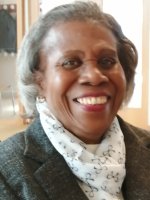
The picture below is the amazing nursing sister who taught me so much. I worked with her as a 3rd year student and was terrified of her. She had a sharp tongue and didn't suffer fools gladly. Then she took me back as a staff nurse and taught me so much about management and how to look after your staff. Later I ended up attending the same church as her and we became friends. She's nearly 80 here and in so much pain from her hips she could barely walk, but she still had a smile to light the world up. She used to train up the house officers and mothered them. Some of them were scared her, but there wasn't much she didn't know. I did a lot of nights as a staff nurse. It was an acute medical ward long before the days of separate admission wards. We always made the doctor's a cuppa when they arrived and often fed them too. They often looked exhausted and needed guidance.
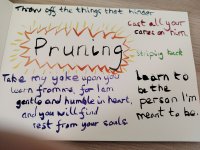
And I've just had a lovely friend visit and was reminded of some pictures I did on a recent retreat not long after my diagnosis. My faith is important to me so there are Bible verses in it. My friend highlighted the comment, "Learn to be the person I'm meant to be.". Maybe something all of us should embrace having spent most of our lives hiding our true selves, feeling we're unacceptable?
 

Attachments

  • IMG_20240526_122833.jpg
    IMG_20240526_122833.jpg
    1.5 MB · Views: 1
  • IMG_20260211_105126.jpg
    IMG_20260211_105126.jpg
    2.7 MB · Views: 1